Emergency Roof Leak Repair & Active Water Intrusion Mitigation in Baton Rouge, LA
Rapid 24/7 telephone dispatch connecting homeowners, estate stewards, and commercial property managers across Baton Rouge, Denham Springs, and Ascension Parish with qualified local emergency roofing crews.
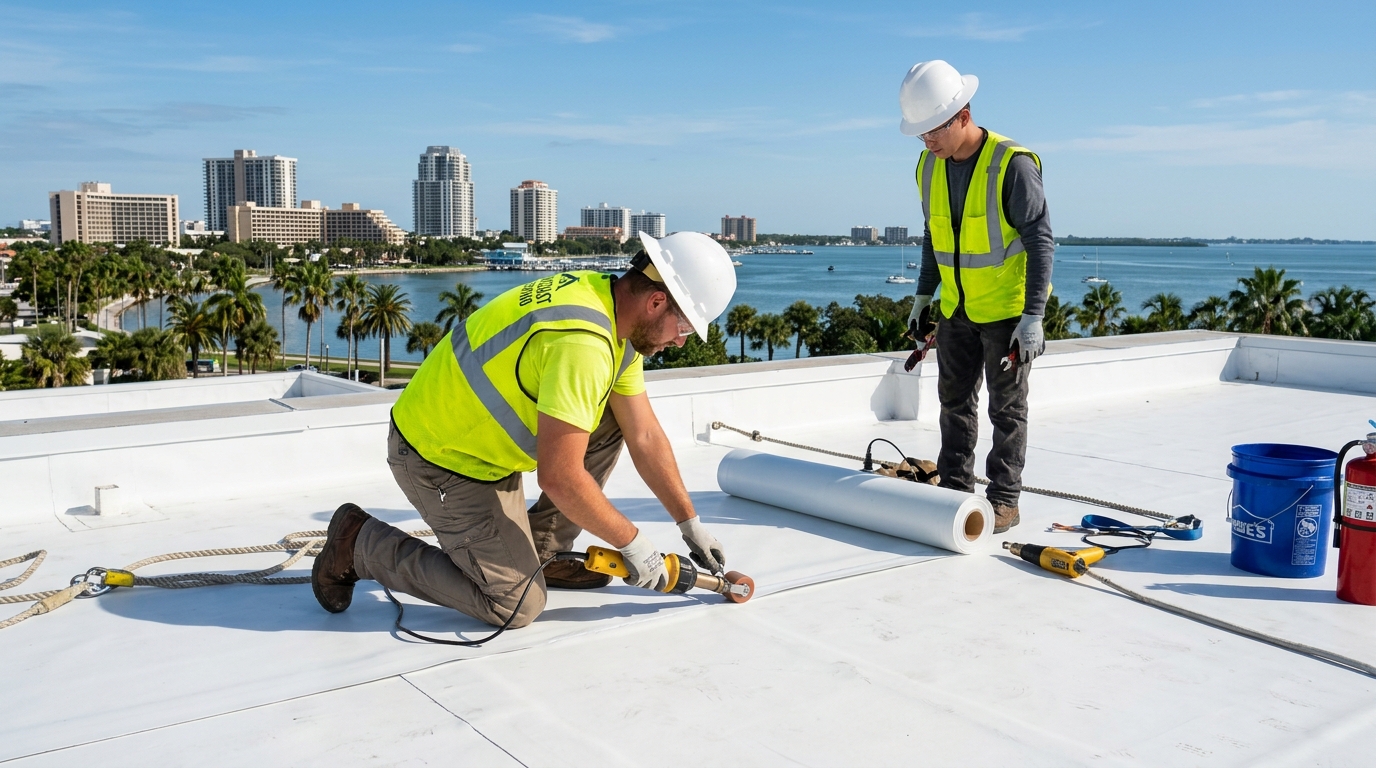
Active Water Intrusion Dynamics in East Baton Rouge Parish
A sudden roof leak during a Louisiana subtropical thunderstorm is rarely a minor inconvenience—it is an active structural emergency. In Baton Rouge, torrential summer squall lines and Gulf tropical feeder bands frequently dump multiple inches of rain within sixty minutes. When combined with sustained 45 to 70+ mph winds, water is forced into roofing assemblies that remain completely watertight under gentle vertical showers.
Water entering a breached roof does not travel in a direct vertical path. Instead, moisture tracks along roof rafters, follows the seams of tongue-and-groove decking or oriented strand board (OSB), migrates across polyethylene ceiling vapor barriers, and pools over low spots in gypsum drywall before finally penetrating into living spaces. By the time water visibly drips from a ceiling light fixture or drywall seam, gallons of water may already be trapped inside your attic insulation envelope.
Emergency dispatch provides immediate access to experienced roofing technicians trained in hydrostatic leak containment. Field crews prioritize arresting active water flow, deploying interior water diversion funnels, and applying specialized hydrophobic sealing compounds capable of curing even on soaking-wet substrates while heavy rains continue.
1. Regional Microclimate Dynamics & Severe Storm Exposure in Baton Rouge
Baton Rouge's position along the Mississippi River basin places property owners in a high-risk zone for severe weather. Convective squall lines moving across the Atchafalaya basin frequently collide with warm, moisture-laden air masses rising from the Gulf of Mexico, triggering intense supercell thunderstorms characterized by straight-line wind bursts exceeding 75 mph and torrential rainfall rates up to 4 inches per hour.
These severe microclimate conditions exert immense dynamic pressure on building envelopes. As high-velocity winds flow over a roof ridge or parapet, localized aerodynamic eddies create powerful negative pressure suction forces on leeward and corner slopes. If asphalt shingles, edge metal, or flashing membranes possess even minor installation defects or age-related fatigue, these suction vortices peel back protective layers, creating immediate entry points for wind-driven rain.
2. Non-Destructive Moisture Diagnostics & FLIR Thermal Tracing
Accurately isolating the source of a roof leak during or immediately following a severe storm requires specialized forensic diagnostic equipment. Water frequently enters a roof at a high point—such as a deteriorated ridge vent or upper valley transition—and travels dozens of feet along rafters or sheathing seams before dripping through a living room ceiling.
Responding technicians utilize advanced forward-looking infrared (FLIR) thermal imaging cameras. Because wet insulation and saturated wood sheathing retain heat differently than dry building materials, FLIR cameras detect subtle temperature differentials (delta T) as low as 0.1°C, producing distinct thermal gradients that reveal exact moisture migration pathways without destructive ceiling cuts. Non-penetrating electromagnetic impedance moisture meters are then used to measure exact moisture percentages within structural wood rafters and gypsum decking.
3. Step-by-Step Substrate Restoration & Structural Repair Methodology
When water intrusion has compromised structural roof decking, a durable restoration requires systematic carpentry and membrane engineering:
- Hazard Assessment & Tarp Containment: The work area is secured, fall arrest systems are anchored to structural framing, and temporary weatherproofing is deployed to protect the building during restoration.
- Selective Demolition: Compromised, buckled, or mold-contaminated oriented strand board (OSB) and plywood decking are excised back to the sound centerlines of adjacent roof rafters using depth-calibrated circular saws.
- Structural Framing Inspection: Exposed rafters, collar ties, and top plates are inspected for wood rot or fungal colonization. Rafters showing fungal decay are sistered with structural-grade Southern Yellow Pine dimensional lumber secured with structural framing screws.
- Substrate Panel Replacement: APA-rated 5/8-inch or 3/4-inch CDX exterior-grade plywood panels are precision-cut and fastened with hot-dipped ring-shank 8d nails spaced 6 inches on center along panel edges and 12 inches on center across intermediate supports. H-clips are installed between unsupported panel edges to prevent deflection.
- Hydrostatic Membrane Underlayment: High-temperature self-adhering SBS modified rubberized asphalt ice-and-water barrier is applied directly to the bare wood deck, sealing completely around nail penetrations.
- Finish Material Re-Integration: Matching architectural shingles, standing seam metal panels, or low-slope modified bitumen membranes are layered into existing courses following strict Louisiana high-wind fastening schedules.
4. State Energy Codes & Louisiana Contractor Licensing (LSLBC) Compliance
Roof restorations in Baton Rouge must adhere strictly to Louisiana state regulatory frameworks. Under Title 37 of the Louisiana Revised Statutes, all residential home improvement and roofing projects exceeding ,500 must be performed by contractors holding valid registration with the Louisiana State Licensing Board for Contractors (LSLBC). Commercial projects exceeding ,000 mandate an active Commercial Specialty Roofing license.
Furthermore, the Louisiana State Uniform Construction Code (LSUCC) mandates compliance with the 2021 International Energy Conservation Code (IECC) and International Residential Code (IRC). Re-roofing projects that remove existing roof coverings down to the deck must incorporate appropriate thermal insulation values (minimum R-38 in unconditioned attics) and compliant attic ventilation ratios (1 square foot of net free ventilating area per 300 square feet of attic space) to prevent summer heat buildup and winter condensation.
5. Preventative Property Maintenance & Storm Preparedness
Proactive property maintenance significantly reduces the likelihood of catastrophic roof failures during severe weather events. Property owners across Baton Rouge should implement a regular seasonal inspection routine:
- Overhanging Tree Canopy Clearance: Maintain at least a 10-foot clearance between tree branches and roof surfaces. Heavy live oak and loblolly pine limbs can scrape ceramic granules from shingles and cause severe puncture damage when felled by hurricane gusts.
- Debris Clearance in Valleys & Gutters: Regularly remove fallen leaves, pine needles, and organic debris from roof valleys, crickets, and gutter systems. Organic blockages trap moisture, fostering wood rot and creating backwater dams during deluge rainfall.
- Penetration Collar Inspections: Inspect rubber plumbing boot flashings, HVAC exhaust jacks, and skylight perimeter seals bi-annually. Replace weathered rubber collars before active leaks penetrate living areas.
- Attic Inspection After High Winds: Following any severe wind event, inspect attic cavities with a high-lumen flashlight to check for damp insulation, water stains on underside decking, or daylight visible through roof transitions.
Need Emergency Assistance in Baton Rouge?
Do not wait for active water leaks to cause electrical short circuits or ceiling drywall collapses. Connect immediately with our 24/7 telephone triage desk to dispatch independent licensed roofing professionals to your property.