Gonzales Emergency Roof Tarping & Active Leak Mitigation
24/7 emergency telephone triage connecting Ascension Parish commercial properties and residential estates with independent licensed roofing professionals.
Gonzales Commercial & Residential Roof Storm Dynamics
As the commercial heart of Ascension Parish and the 'Jambalaya Capital of the World,' Gonzales features a diverse architectural landscape comprising major commercial retail corridors along Interstate 10 and established single-family residential neighborhoods along Burnside Avenue and Highway 30.
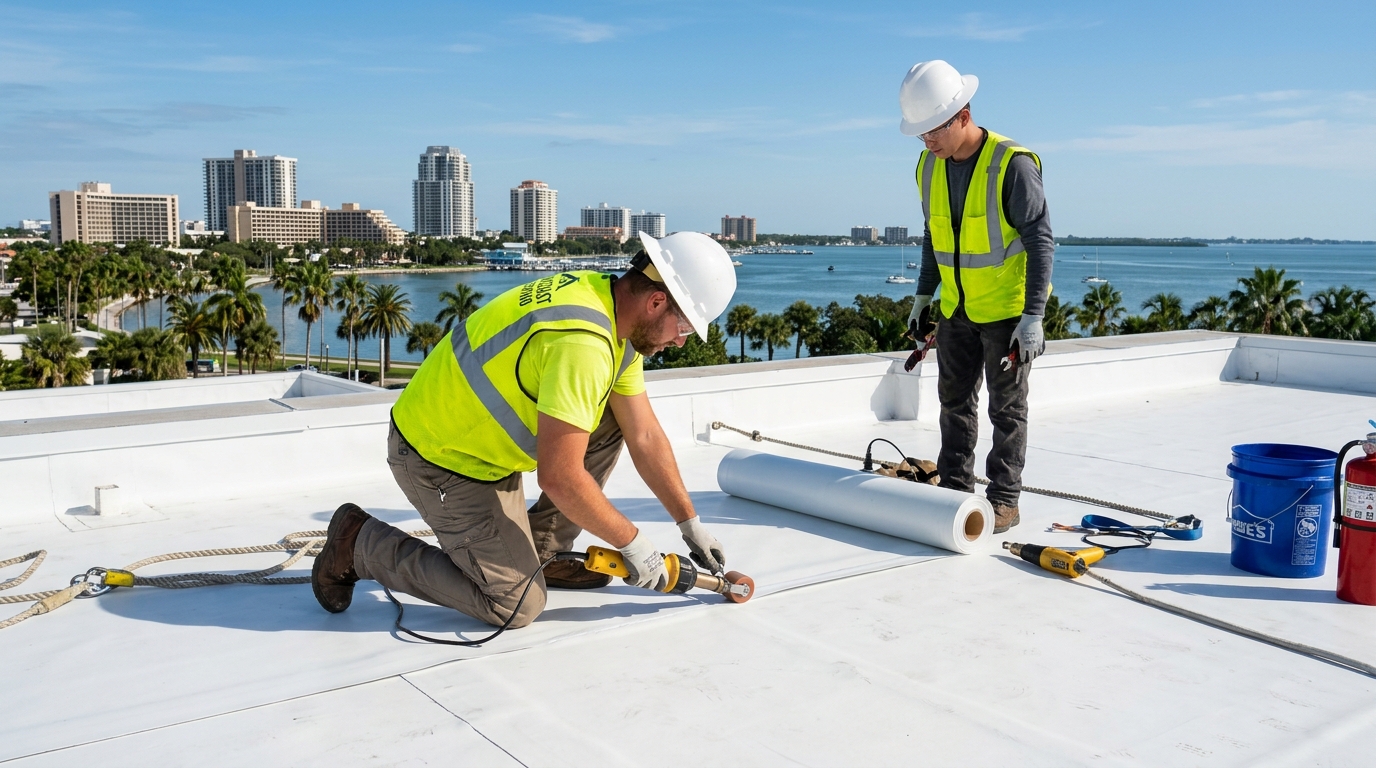
Tropical storms and severe convective thunderstorm fronts frequently subject Gonzales commercial buildings to extreme hydraulic ponding loads. Large low-slope built-up asphalt, modified bitumen, and single-ply TPO roofs accumulate thousands of gallons of standing water within minutes. When perimeter scuppers or internal roof drains become clogged with wind-blown debris, hydrostatic head pressure forces water through aging seam welds and parapet wall coping joints.
For residential properties, emergency tarping is essential to secure exposed roof sheathing against recurring subtropical downpours. Responding technicians utilize 10-mil woven poly tarps secured with 2x4 spruce furring battens screwed directly into structural roof joists, providing durable weatherproofing that withstands subsequent 60+ mph wind gusts while insurance documentation is finalized.
1. Microclimate Dynamics & Severe Storm Stresses in Gonzales, LA
Property owners in Gonzales face the compound atmospheric hazards of high humidity, extreme summer solar ultraviolet degradation, and sudden convective storm violence. In Ascension Parish, thermal updrafts created by intense solar heating over agricultural fields and river corridors frequently trigger late-afternoon severe thunderstorms with little advance warning.
These localized storms generate high-velocity straight-line winds, intense downbursts, and pea- to golf-ball-sized hail. When winds exceed 60 mph, air flow separates along eaves and rakes, generating intense localized aerodynamic suction. Shingles whose adhesive sealant strips have become brittle from years of subtropical heat shear away at the fastener line. Once shingles blow off, torrential rain penetrates directly behind roof underlayment courses.
2. FLIR Infrared Moisture Diagnostics & Forensic Evaluation
Following a severe storm in Gonzales, pinpointing the exact entry point of water intrusion requires scientific testing rather than guesswork. Water entering a roof penetration or displaced shingle course often tracks along the underside of roof sheathing or down structural rafters before penetrating living room ceilings dozens of feet away.
Responding technicians utilize advanced forward-looking infrared (FLIR) thermal imaging cameras. Operating on high-sensitivity thermal sensors, FLIR cameras detect microscopic temperature differences between damp, water-saturated insulation and dry materials, creating clear thermal maps of trapped attic moisture. Technicians accompany thermal scans with calibrated electronic pinless moisture meters to quantify moisture percentages within structural wood rafters and drywall.
3. Structural Substrate Restoration & Carpentry Methodology
When roof sheathing has suffered structural rot or storm puncture damage, a durable restoration requires systematic carpentry and membrane engineering:
- Safety Stabilization & Hazard Containment: Fall arrest lines are secured to structural roof trusses, and temporary weatherproofing shields are positioned to safeguard the structure during restoration.
- Selective Demolition: Damaged, buckled, or mold-contaminated oriented strand board (OSB) and plywood decking are excised back to the sound centerlines of adjacent roof rafters using depth-calibrated saws.
- Truss & Rafter Inspection: Structural framing is inspected for rot or deflection. Compromised rafters are sistered with structural-grade Southern Yellow Pine dimensional lumber secured with structural screws.
- Substrate Panel Replacement: APA-rated 5/8-inch or 3/4-inch CDX exterior-grade plywood panels are installed with hot-dipped ring-shank 8d nails spaced 6 inches on center along panel edges and 12 inches on center across intermediate supports. H-clips are placed between unsupported panel edges.
- High-Temperature Underlayment: Self-adhering SBS modified rubberized asphalt ice-and-water barrier is applied directly to the bare wood deck, sealing completely around nail penetrations.
- Finish Material Re-Integration: Matching architectural shingles, standing seam metal panels, or low-slope modified bitumen membranes are layered into existing courses following strict Louisiana high-wind fastening schedules.
4. State Contractor Licensing (LSLBC) & Code Compliance in Ascension Parish
All emergency stabilization, tarping, and permanent roofing work in Gonzales must adhere to Louisiana state regulatory frameworks. Under Title 37 of the Louisiana Revised Statutes, residential roofing projects exceeding ,500 must be executed by contractors holding active registration with the Louisiana State Licensing Board for Contractors (LSLBC). Commercial projects exceeding ,000 mandate an active Commercial Specialty Roofing license.
Furthermore, local parish building permits and the Louisiana State Uniform Construction Code (LSUCC) enforce the 2021 International Residential Code (IRC) high-wind fastening mandates—requiring 6 nails per architectural shingle rather than standard 4 nails in high-wind zones—and mandatory self-adhering ice-and-water shield membranes along eaves, valleys, and critical wall transitions.
5. Seasonal Property Maintenance & Severe Storm Preparedness
Proactive maintenance protects Gonzales properties against severe storm damage:
- Tree Canopy Management: Maintain a minimum 10-foot clearance between tree branches and roof edges to prevent branch rubbing and impact punctures during storm gusts.
- Valley & Gutter Debris Removal: Clear accumulated leaves and pine needles from valleys and gutters to prevent water pooling and damming during torrential downpours.
- Penetration Collar Inspection: Inspect rubber plumbing boot flashings and chimney counter-flashings bi-annually, replacing weathered rubber collars before active leaks penetrate living areas.
- Post-Storm Attic Checks: Following any severe wind event, inspect attic cavities with a high-lumen flashlight to identify damp insulation, water stains on underside decking, or daylight visible through roof transitions.
Immediate Dispatch in Gonzales, LA
Experiencing an active roof leak or missing shingles? Speak directly with our dispatch triage desk at (888) 208-4155. We connect you with independent, licensed local roofing specialists ready to protect your Gonzales home.